




When selecting and purchasing magnets, understanding their core performance indicators is crucial to ensuring they fit your specific application scenarios. These indicators directly determine the magnet’s working efficiency, stability and service life, and are widely used in industrial production, product R&D and daily application selection. Below is a detailed introduction to the most important performance indicators of magnets, explained in practical terms without complex professional jargon.
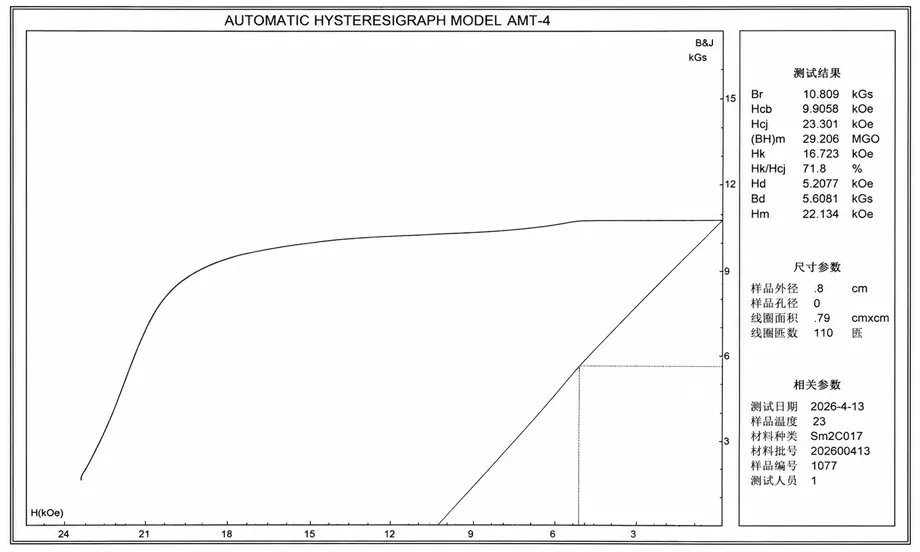
1. Magnetic Energy Product (BHmax)
The magnetic energy product is the most core indicator to measure the magnetic strength of a magnet, expressed in MGOe (Mega Gauss Oersted). Simply put, it reflects how much magnetic energy a magnet can store and release. The higher the BHmax value, the stronger the magnet’s magnetic force and the more powerful its ability to attract or repel other magnetic materials.
For example, sintered NdFeB magnets usually have a BHmax of 28-52 MGOe, making them the strongest permanent magnets currently available. In contrast, ferrite magnets have a lower BHmax, generally between 0.8-5 MGOe, which is suitable for scenarios that do not require strong magnetic force, such as refrigerator stickers and door seals. When you need a magnet to lift heavy objects or work in a long-distance magnetic field, choosing a product with a high BHmax is essential.
2. Coercivity (Hc)
Coercivity refers to the ability of a magnet to resist demagnetization, which is divided into intrinsic coercivity (Hci) and coercive force (Hcb). The higher the coercivity, the more difficult it is for the magnet to lose its magnetism under external influences such as high temperature, external magnetic fields, or vibration.
Intrinsic coercivity (Hci) is more commonly used in practical applications, as it directly reflects the magnet’s long-term magnetic stability. For instance, samarium cobalt magnets have a high Hci (usually above 10 kOe), so they can maintain stable magnetic properties even at high temperatures (up to 500℃), making them ideal for high-temperature working environments like aerospace and high-temperature motors. On the other hand, some low-cost ferrite magnets have lower Hci, so they should be avoided in high-temperature or strong external magnetic field scenarios to prevent demagnetization.
3. Remanence (Br)
Remanence, also known as residual magnetic induction, is the magnetic induction intensity remaining in the magnet after the external magnetic field is removed during magnetization. It is expressed in Gauss (G) or Tesla (T), and directly determines the surface magnetic field strength of the magnet.
A higher remanence means the magnet can maintain a stronger magnetic field after magnetization. For example, a sintered NdFeB magnet may have a remanence of 12,000-14,000 G, so it can generate a strong surface magnetic field, which is suitable for applications such as magnetic wireless chargers and precision sensors. In contrast, rubber magnets have a lower remanence (usually 1,000-3,000 G), which is sufficient for lightweight adsorption scenarios like advertising magnetic stickers.
4. Curie Temperature (Tc)
Curie temperature is the critical temperature at which a magnet loses its magnetic properties completely. When the magnet’s working temperature exceeds the Curie temperature, its magnetic properties will disappear permanently and cannot be recovered, so this indicator is particularly important for magnets used in high-temperature environments.
Different magnet materials have very different Curie temperatures. Samarium cobalt magnets have the highest Curie temperature, around 700-850℃, followed by AlNiCo magnets (500-600℃), sintered NdFeB magnets (310-400℃), and ferrite magnets (450-550℃). For example, if you need a magnet for a high-temperature motor that works at 300℃, a sintered NdFeB magnet with a Curie temperature above 350℃ is suitable, while a ferrite magnet, despite its high Curie temperature, may not meet the magnetic strength requirements.
5. Working Temperature (Tw)
Working temperature is different from Curie temperature; it refers to the maximum temperature at which the magnet can maintain stable magnetic properties (usually no more than 5% loss of magnetic properties) during long-term use. It is a more practical indicator for daily application selection, as it directly relates to the magnet’s service life in actual working conditions.
For example, regular sintered NdFeB magnets have a working temperature of 80-120℃, while high-temperature resistant models can reach 150-200℃. Rubber magnets have a lower working temperature, generally between -20℃ and 80℃, so they cannot be used in high-temperature environments such as near engine compartments. When selecting a magnet, you must match its working temperature with the actual environment to avoid magnetic loss and product failure.
Practical Application Tips
These performance indicators are not independent; they need to be considered comprehensively. For example, in industrial motors, you need a magnet with high magnetic energy product (strong magnetic force) and high coercivity (stable performance); in high-temperature instruments, Curie temperature and working temperature are the top priorities; in civilian products like refrigerator stickers, low cost and appropriate remanence are more important.
By understanding these key performance indicators, you can better communicate your needs with suppliers, select the most suitable magnet products, and avoid unnecessary losses caused by improper selection.


