




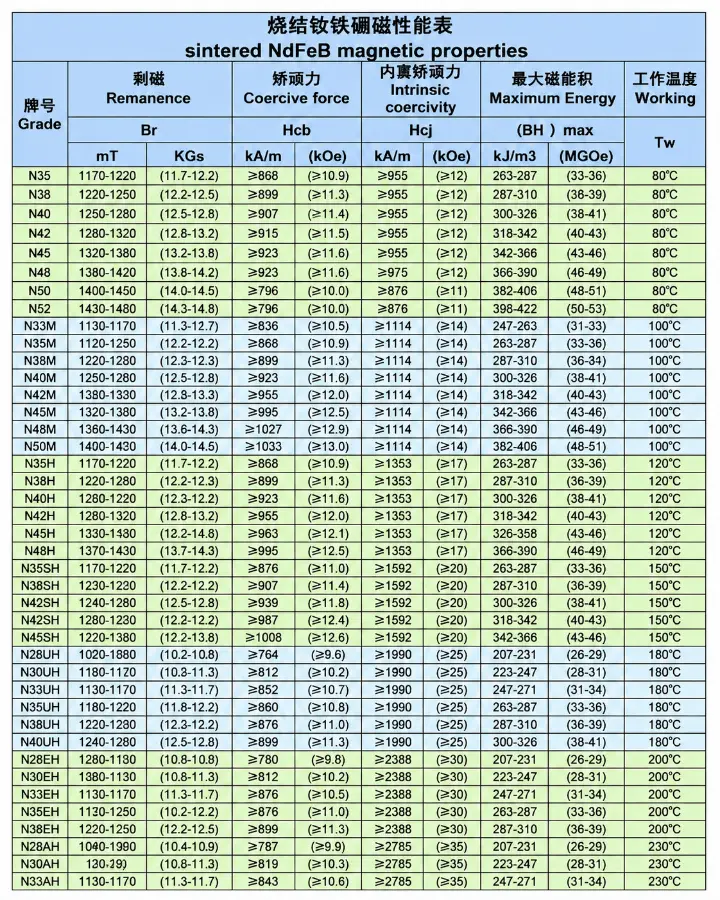
Sintered neodymium iron boron (NdFeB) magnets are the strongest commercially available permanent magnets, widely used in motors, sensors, consumer electronics, and industrial equipment. Their performance is precisely defined by standardized grades, each with tailored magnetic properties to suit specific application requirements. This guide breaks down the key parameters, grade structure, and practical selection logic based on the performance specifications.
Core Magnetic Performance Parameters
Every sintered NdFeB grade is defined by five critical metrics, as shown in the table:
| Parameter | Symbol | Units | Practical Meaning |
| Remanence | Br | mT / kGs | The residual magnetic flux density after full magnetization. Directly determines the surface magnetic strength of the magnet. Higher values mean stronger magnetic pull for a given size. |
| Coercive Force | Hcb | kA/m / kOe | The resistance to demagnetization by an external reverse magnetic field. Ensures the magnet maintains its magnetization during operation. |
| Intrinsic Coercivity | Hci | kA/m / kOe | The material’s inherent ability to resist demagnetization, even at high temperatures or under external magnetic interference. This is the key metric for long-term stability. |
| Maximum Energy Product | (BH)max | kJ/m³ / MGOe | The primary indicator of magnetic strength, representing the maximum magnetic energy the magnet can store and deliver. Higher values allow for smaller, lighter magnets in high-force applications. |
| Maximum Working Temperature | Tw | °C | The highest continuous operating temperature the magnet can withstand without significant irreversible demagnetization. |
Decoding the NdFeB Grade Naming System
Sintered NdFeB grades follow a universal naming convention, such as N35, N42M, N50SH, which encodes both magnetic strength and temperature resistance:
- The Number (e.g., 35, 42, 50): Represents the nominal maximum energy product ((BH)max) in MGOe. A higher number means a stronger magnet (e.g., N50 is significantly stronger than N35).
- The Suffix (N, M, H, SH, UH, EH, AH): Indicates the intrinsic coercivity (Hci) and maximum working temperature. This is the critical factor for high-temperature or demagnetization-prone environments.
| Suffix | Common Name | Typical Hci (kOe) | Max Working Temperature |
| N | Low coercivity | ≥12 | 80°C |
| M | Medium coercivity | ≥14 | 100°C |
| H | High coercivity | ≥17 | 120°C |
| SH | Super high coercivity | ≥20 | 150°C |
| UH | Ultra high coercivity | ≥25 | 180°C |
| EH | Extra high coercivity | ≥30 | 200°C |
| AH | Ultra-extra high coercivity | ≥35 | 230°C |
Grade Series and Application Use Cases
The grades are organized into series based on their suffix, each designed for distinct operating conditions:
1. Standard "N" Series (Tw = 80°C)
- Grades: N35 to N52
- Core Features: The most common, cost-effective grades with the highest magnetic strength-to-cost ratio. Hci ≥12 kOe.
- Applications: General-purpose motors, consumer electronics (speakers, magnetic closures), and low-temperature environments where demagnetization risk is minimal. For example, N52 offers the highest magnetic strength in this series, ideal for compact, high-force applications like wireless chargers.
2. "M" Series (Tw = 100°C)
- Grades: N33M to N50M
- Core Features: Improved coercivity (Hci ≥14 kOe) for enhanced stability at slightly elevated temperatures.
- Applications: Household appliances, automotive auxiliary components, and industrial motors operating in moderate heat environments. The N42M grade, for instance, balances strength and stability for common pump and fan motors.
3. "H" Series (Tw = 120°C)
- Grades: N35H to N48H
- Core Features: High coercivity (Hci ≥17 kOe), suitable for environments with consistent heat exposure.
- Applications: Automotive drive motors, power tools, and industrial automation equipment. These grades prevent demagnetization during prolonged operation in warm conditions.
4. "SH" Series (Tw = 150°C)
- Grades: N35SH to N45SH
- Core Features: Super high coercivity (Hci ≥20 kOe), offering robust resistance to both heat and external magnetic fields.
- Applications: Electric vehicle traction motors, aerospace components, and heavy-duty industrial machinery where temperature fluctuations and magnetic interference are common.
5. High-Temperature "UH, EH, AH" Series (Tw = 180–230°C)
- Grades: N28UH to N33AH
- Core Features: Ultra-high coercivity (Hci ≥25–35 kOe), engineered for extreme heat environments. While their (BH)max is lower than standard grades, their stability is unmatched.
- Applications: High-performance automotive systems, oil and gas equipment, and aerospace components operating in temperatures up to 230°C. These grades ensure long-term reliability where standard NdFeB magnets would rapidly lose magnetization.
Key Trade-Offs in Grade Selection
When choosing a grade, engineers must balance three critical factors:
- Magnetic Strength vs. Temperature Resistance: Higher coercivity grades (e.g., EH, AH) offer better heat stability but have slightly lower maximum energy product. Conversely, high-strength grades like N52 have excellent magnetic output but limited temperature tolerance.
- Cost vs. Performance: Higher coercivity grades require more advanced manufacturing processes, making them more expensive. For applications with no extreme heat exposure, standard "N" or "M" series grades offer the best value.
- Demagnetization Risk: If the magnet will be exposed to external magnetic fields, vibration, or high temperatures, prioritize grades with higher Hci to prevent irreversible performance loss.
Final Thoughts
The wide range of sintered NdFeB grades allows precise customization for nearly any application. By understanding the naming system and core performance parameters, engineers can select the optimal grade to meet both magnetic strength and environmental stability requirements. Whether for a low-temperature consumer device or a high-heat industrial motor, there is a sintered NdFeB grade tailored to the task.


