




Samarium-cobalt (SmCo) magnets, especially the 2:17 type (Sm₂Co₁₇), represent one of the most advanced families of permanent magnet materials. Renowned for their exceptional temperature stability, high coercivity, and resistance to demagnetization, these magnets are indispensable for high-performance applications in aerospace, defense, and industrial systems. Unlike other magnet types, their performance is meticulously defined by standardized grades, each tailored to a specific balance of magnetic properties. This guide breaks down the key performance parameters and grade specifications for 2:17 SmCo magnets.
Understanding the Core Performance Parameters
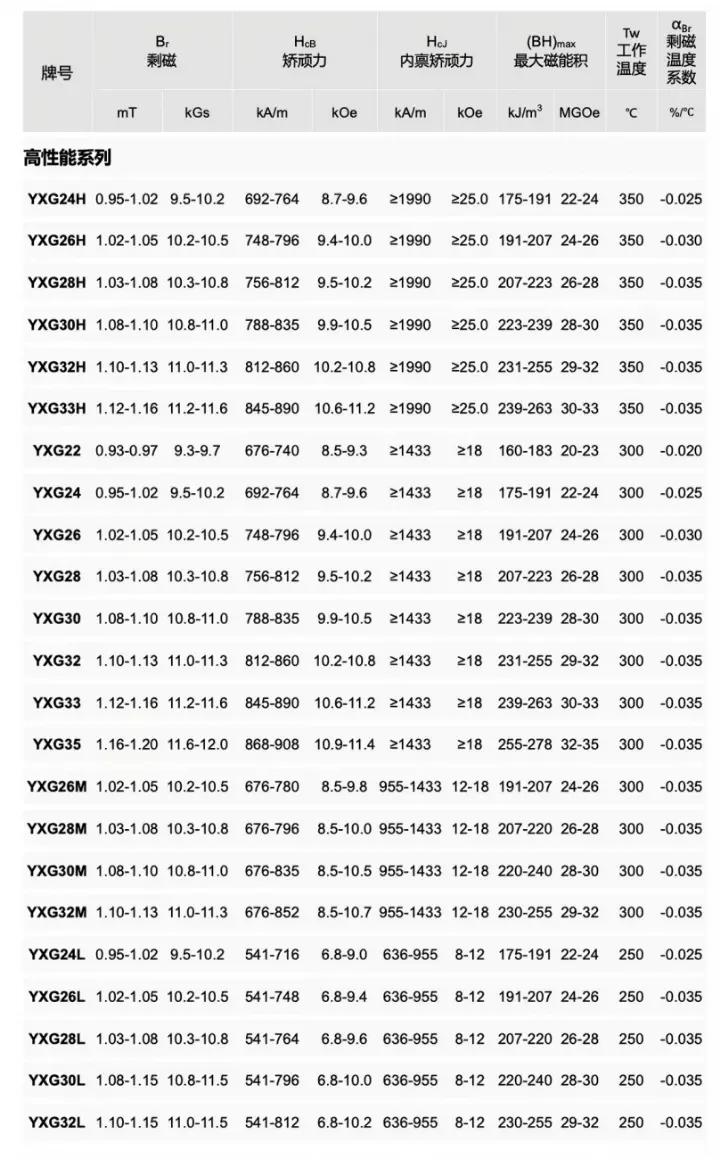
To select the correct grade, it is essential to understand the standardized metrics used to define their performance, as seen in the provided specification table:
| Parameter | Symbol | Unit | Description |
| Remanence | Br | mT / kGs | The residual magnetic flux density after magnetization. A higher value indicates stronger surface magnetic strength. |
| Coercivity | HcB | kA/m / kOe | The measure of a magnet's resistance to demagnetization by an opposing magnetic field. |
| Intrinsic Coercivity | HcJ | kA/m / kOe | The material's inherent ability to resist demagnetization, critical for stability at high temperatures. |
| Maximum Energy Product | (BH)max | kJ/m³ / MGOe | The primary indicator of magnetic strength, representing the maximum energy a magnet can deliver. |
| Max Working Temperature | Tw | °C | The maximum continuous operating temperature without significant performance loss. |
| Temperature Coefficient of Br | αBr | %/°C | Defines how much the remanence decreases with increasing temperature. Lower values mean greater stability. |
A Closer Look at 2:17 SmCo Grades
The grades listed in the table follow a structured naming convention (e.g., YXG24H, YXG33, YXG26L), which hints at their performance and application range. They are broadly categorized into three series based on their maximum working temperature, a key differentiator for high-temperature environments.
1. The High-Performance "H" Series (Tw = 350°C)
This series is engineered for the most demanding high-temperature applications. With a working temperature of 350°C, these grades are the go-to choice for aerospace and defense systems.
- Key Features: High intrinsic coercivity (HcJ ≥ 1990 kA/m / ≥25 kOe), enabling them to maintain magnetization at extreme temperatures.
- Grade Range: YXG24H to YXG33H.
- Performance Gradient: As the grade number increases (e.g., from 24H to 33H), both the remanence (Br) and maximum energy product ((BH)max) increase, indicating a stronger magnet.
- Example: YXG30H offers a Br of 1.08-1.10 mT (10.8-11.0 kGs) and a (BH)max of 28-30 MGOe, suitable for high-temperature motors and sensors.
2. The Standard Series (Tw = 300°C)
This is the most common series, offering a versatile balance of performance and cost for applications requiring stability up to 300°C.
- Key Features: Intrinsic coercivity (HcJ ≥ 1433 kA/m / ≥18 kOe), which is sufficient for most industrial high-temperature scenarios.
- Grade Range: YXG22 to YXG35.
- Notable Subset: "M" Grades: The M suffix (e.g., YXG26M) denotes grades optimized for applications where a slightly lower coercivity is acceptable, often used to meet specific cost targets while maintaining good magnetic strength.
3. The Low-Temperature "L" Series (Tw = 250°C)
This series caters to applications where the primary concern is not the absolute highest temperature resistance, but rather high magnetic performance at moderate elevated temperatures.
- Key Features: A lower coercivity threshold (HcJ ≥ 636 kA/m / ≥8 kOe), which allows for higher remanence values and stronger magnetic output.
- Grade Range: YXG24L to YXG32L.
- Application Fit: Ideal for high-performance medical devices, precision instruments, and specialized motors operating in controlled environments up to 250°C.
The Practical Advantage of Low Temperature Coefficient
A defining characteristic of all 2:17 SmCo grades is their very low temperature coefficient of remanence (αBr), typically between -0.020%/°C and -0.035%/°C.
- What this means: Unlike neodymium magnets, which can lose over 10% of their strength when heated from room temperature to 100°C, SmCo magnets experience a far more gradual decline.
- Why it matters: This stability is critical for precision applications, such as gyroscopes or navigation sensors, where consistent magnetic performance across varying environmental temperatures is non-negotiable.
How to Choose the Right Grade
Selecting the correct grade involves balancing three core factors:
- Required Magnetic Strength: Look at the (BH)max and Br values to ensure the magnet is strong enough for the application.
- Operating Temperature: Select the "H", standard, or "L" series based on the maximum continuous temperature the magnet will see. Always add a safety margin.
- Demagnetization Risk: If the magnet will be exposed to external magnetic fields or operate at the high end of its temperature range, prioritize grades with the highest HcJ (intrinsic coercivity).
By understanding these grades and their parameters, engineers can precisely specify the optimal Sm2Co17 magnet for their most challenging applications, ensuring reliability and performance where other magnets cannot operate.


